|
On this page I will add any new discoveries or new information, or things not previously included on earlier pages.
In Sept 2009 I was looking for Gua Sanding on Gunung Gajah in Perak, and came across a cave new to me, which I have named Cable Cave. There was some interesting cave fauna, including something I have never seen before in a cave. It was only about 1cm long and above my head so taking a good photo was not easy (1st photo).
The 2nd & 3rd photos show the snares - sticky silk threads - spun by the larva of the fungus gnat. These are commonly found in caves. The larva can be seen in the 3rd photo.
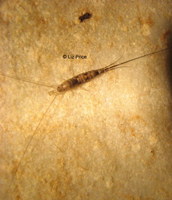
Dr John Irish in Namibia identified it from a photo as a bristletail, of the order Archaeognatha (alternatively Microcoryphia). It is a herbivore specialising on mold and lichens. |
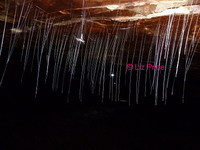
snares of fungus gnat larva |
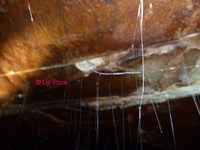
the larva |
Cockroaches
Cockroaches lay eggs. A mass of eggs are contained in the ootheca, which is an egg case or capsule, made of protein. Ootheca is derived from Greek words, oo - egg, theca - cover or container. The American cockroach produces the case 3-7 days after mating and it hardens as she carries the egg case protruding from the tip of her abdomen for another 2 days before it is deposited in a hidden location. Each egg case contains an average of 14 embryos. The immature cockroaches will emerge in 24 to 38 days. The juvenile cockroaches will go through 7 to 8 moults before they become mature. I have often seen empty cases in caves. The first photo, from Gomantong Cave, shows the lower cockroach in the process of laying an ootheca.
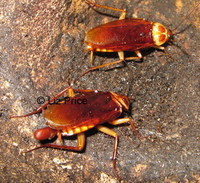
American cockroach, Periplaneta americana laying an ootheca |
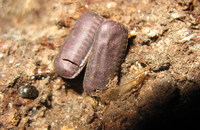
empty ootheca, Gunung Senyum |
Scorpions
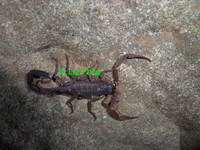
I very rarely see scorpions in caves in Malaysia, or in other caves in southeast Asia. So it was quite special to see 3 scorpions together in Gua Tempurung (March 2012). Dr Lourenço in France identified them as family Buthidae and most certainly genus Lychas. They are common in the region and are not true troglobites, but these ones were seen quite far inside the cave.
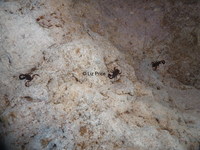
3 scorpions Gua Tempurung |
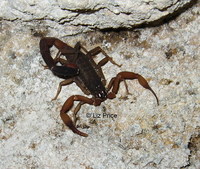
Gua Tempurung |
Gua Jinjang Pelamin, Merapoh |
Whip spider mother
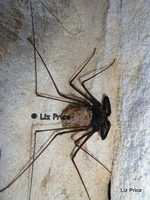
This is my first sighting in a cave of a whip spider with babies. Whip spiders or amblypygids are arachnids. ambly = blunt, and pygi = rumps
Unlike true spiders which have 8 legs, with whip spiders the first pair of legs has developed into long whiplike feelers that are three to four times longer than the remaining three pairs of legs.
Having been caving in Merapoh a few times recently, I have noticed that there are a lot of whip spiders in the caves. They are of the genus Stygophrynus. This whip spider was seen in Gua Hanuman in Merapoh.
It was very exciting to see this mother with her babies on her back. After the eggs hatch, the babies climb onto the mother's back.
|
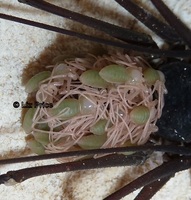
Close up of the young. The pink 'strings' are the legs of the babies. The babies are newly moulted and are not yet fully pigmented and sclerotised. |
Birds on limestone hills
There are two types of thrushes often seen around cave entrances. One is the Blue Whistling Thrush, (Myophonus caeruleus crassirostris) (see also BWT) and the other is the Blue Rock Thrush (Monticola solitarius madoci).
At Kek Look Tong temple at Gunung Rapat near Ipoh, the Blue Rock Thrush (BRT) is commonly seen and has become quite tame. It is rather more speckled than the Blue Whistling Thrush (BWT). See paper by KHOO (2012) on the diet of the Blue Whistling Thrushes at Kek Look Tong, which is known to eat other birds and bats.
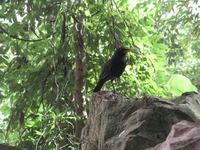
Blue Whistling Thrush at Nam Thean Tong (G.Rapat) |
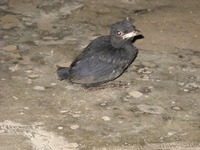
BWT fledgling |
Some trogloxenes
Trogloxenes are animals that enter caves occasionally, maybe for shelter or a food source. These include goats, porupine, pythons, rats etc, and humans. I've never seen a goat in a cave, nor a pig (only dead ones). It is quite common to see goat droppings in Malaysian caves.
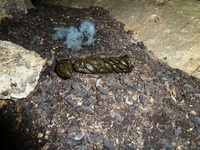
Old and fresh goat droppings |

pig bones |
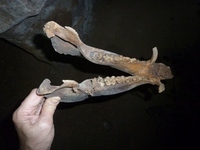
pig jaw |
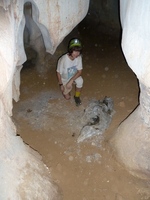
dead wild boar |
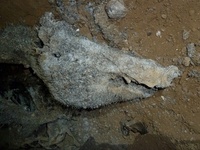
head of boar |
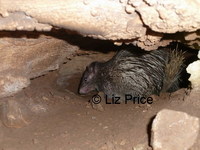
Brush-tailed porcupine |
Fish in caves
Fish in Malaysian caves are probably not true cave dwellers, but have come in from outside. (Thanks to Nick Baker for ID of photos 1 & 3.)
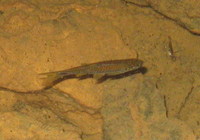
Probably Einthovens Rasbora in a Perlis cave |
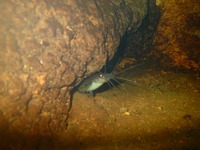
Catfish with 4 pairs of barbels |
Black Snakehead (Channa melasoma) in a cave in Merapoh

© Liz Price 2009 - 2014
Page last updated 26 Apr 2014 |
|